Meme Challenge: Dank Memes
- 4.5
- Rating
- 10.00M
- Installs
- Free
- Price
 Analysis by App-foxy
I went into Meme Challenge: Dank Memes expecting a quick card game built around internet humor, and that is exactly where it makes the strongest first impression. The basic appeal is easy to understand: you create or select meme-style combinations, take on themed challenges, and work toward becoming the player with the sharpest sense of timing and absurdity. It is free to play, aimed at a Teen audience, and developed by MagicLab.
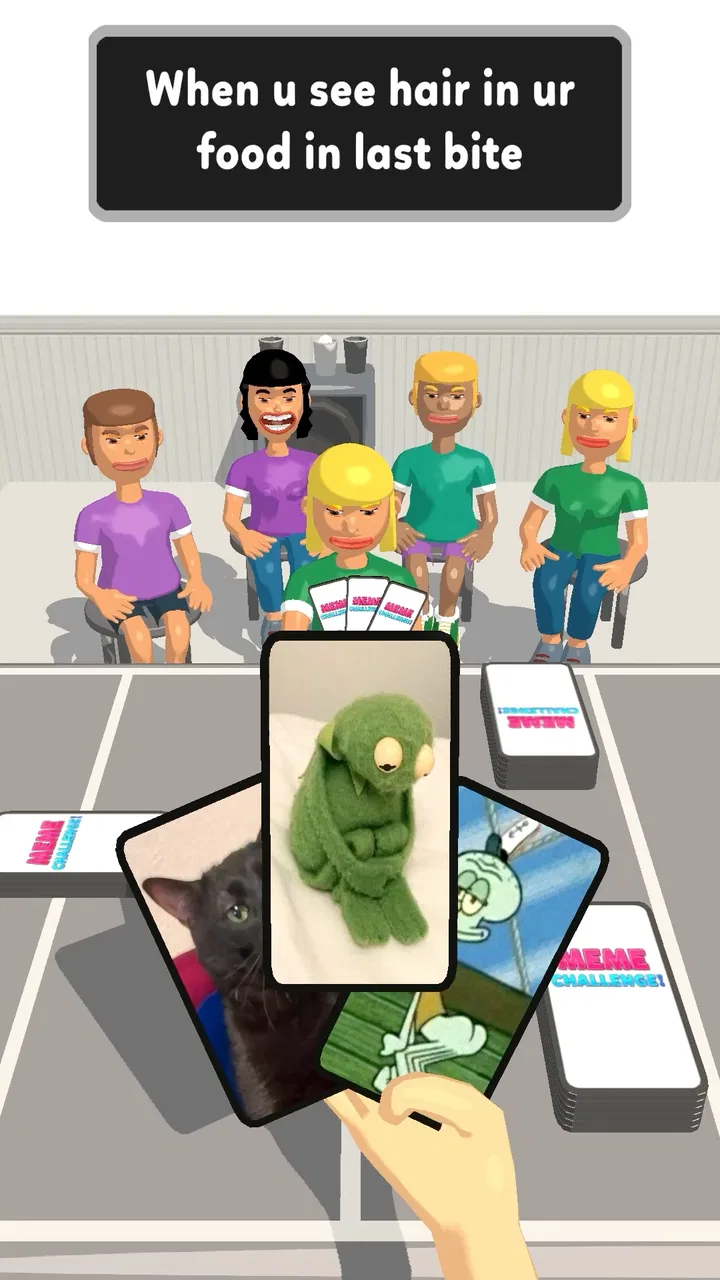
What makes it worth discussing beyond its joke-filled presentation is the way it turns a familiar party activity into a repeatable game loop. You are not simply browsing funny images. You are making choices under a challenge format, judging which response fits best, and learning how the game frames humor. That gives each short session a little more purpose than scrolling through a social feed.
After spending time with it, I see the game as a good fit for players who enjoy casual card games but want something lighter and more social in spirit. I would not recommend it to someone looking for a deep strategy game, a long campaign, or carefully balanced competitive play. Its strengths are quick decisions, recognizable meme culture, and an easygoing pace. Its weaknesses come from the same place: humor is personal, and a format based on jokes can lose its spark when the available choices do not match your taste.
You May Also Like

 Blood Strike: 2.5 Anniversary
Blood Strike’s Loadouts Turn Every Drop Into a Tactical Gamble
A close look at Blood Strike’s custom loadouts: how fast access to signature weapons reshapes its battle royale rhythm, rewards preparation, and narrows the gap between fights.

 Pandora - Music & Podcasts
Pandora’s Music Is Easy to Start, but Harder to Recover
Pandora’s strength is its low-effort path from a seed to a station. Its weak spot is how much confidence it asks you to place in connection, setup, and quiet recovery.

 8 Ball Pool
 Is Built on Rivalries, Rematches, and Routine
A close look at the rivalries, rematches, shared routines, and unanswered safety questions that turn a quick pool match into a persistent mobile community.

 Samsung Music
’s Quiet Strength Is Playing What You Already Own
Its reach comes less from spectacle than from dependable access to a personal library. That simplicity is both the app’s strongest retention engine and its ceiling.

 AccuWeather: Weather Radar
AccuWeather Review: A Quick, Clear Forecast for Everyday Decisions
For everyday plans, the best forecast is the one you can understand quickly. AccuWeather makes rain timing, radar, and local conditions easy to act on, with a few trade-offs.

 Hill Climb Racing
Why Hill Climb Racing Still Turns Crashes Into One More Run
A tiny car, a bumpy hill and one more upgrade: Hill Climb Racing keeps resurfacing because its simple chaos makes every near-miss feel personal.
More From Our News Desk
View All News


How the first goals shape the opening hours
The early goals are simple enough to understand without a tutorial-heavy introduction. You learn what kind of answer the game expects, how the challenge framing affects your choice, and why one meme can work better than another even when both are funny on their own. That early clarity matters because a card game about memes could easily become confusing if the rules were buried under visual noise or slang.
I liked that the opening experience encourages experimentation rather than demanding perfect judgment immediately. At first, I was mostly testing the boundaries of the humor: whether a direct punchline worked better than an unexpected one, whether a familiar reaction image felt too obvious, and how much the prompt changed the value of a card. Those small discoveries create the first meaningful objectives. You are not only trying to finish a round; you are trying to understand the game’s sense of what makes a strong meme.
That is also where the game’s audience becomes clear. Someone already comfortable with meme formats will recognize the rhythm quickly. A player who does not spend much time online may still follow the mechanics, but some references and tones may feel less natural. The Teen content rating is therefore useful context for parents and younger players: this is not presented as a children’s card game, even though the controls and general structure are approachable.
One practical tip helped me enjoy the opening more: I stopped trying to find the objectively funniest option. In a meme challenge, the best answer is often the one that fits the prompt’s mood, not the card that would be funniest in isolation. Treating each round as a small writing decision made the game feel more interactive and less like a random image picker.
The early goals work best when I play in short bursts. A few rounds are enough to understand the immediate objective and get a sense of whether the current set of prompts is clicking with me. If I start a session expecting a substantial adventure, the simplicity becomes noticeable. If I start it expecting a compact card-based comedy game, the opening feels appropriately focused.
What progress feels like in practice
Progress in this kind of game is less about building a character and more about improving your decisions. The useful signal is not just whether I completed a challenge, but whether I am becoming quicker at reading the setup and recognizing the difference between a safe answer and a surprising one. That makes the game’s progression partly mechanical and partly personal.
The challenge structure gives ordinary rounds a reason to exist. A prompt creates a small target, a card offers a possible solution, and the result tells me whether my sense of timing matched the game’s expectations. Even when the outcome is not satisfying, it teaches something about the style the current challenge favors. That feedback is more valuable than simply unlocking another visual item with no connection to play.
I also found that the game rewards a flexible approach. Reusing the same kind of joke can work for a while, but it becomes predictable. Switching between literal, exaggerated, awkward, and deliberately silly responses keeps the decision-making fresher. This is one of the less obvious strengths of the format: the player’s own willingness to vary their choices becomes part of the progression.
There is a trade-off here. Players who want visible, long-term advancement may find the loop less compelling than a traditional collectible card game. In a deeper card battler, progress might involve deck construction, resource management, or carefully planned synergies. Here, the satisfaction comes more from solving the current comedic prompt and seeing how your judgment develops. That is a valid form of progression, but it will not satisfy everyone.
The game’s popularity suggests that the concept has broad appeal. It has passed ten million installs and holds a 4.5 average from roughly 175 thousand ratings, which places it comfortably among widely played casual card experiences. Those figures do not guarantee that every joke will land for every player, but they do indicate that the central idea is easy for many people to pick up.
For someone deciding whether to try it, the key question is not whether you like memes in general. It is whether you enjoy making quick selections from limited options. If you prefer creating memes from scratch, a dedicated image editor or meme generator will give you more control. If you like judging and responding within a playful card format, this game offers a more structured alternative.
Challenge pacing and the difficulty curve
The difficulty curve is not the same as in a conventional strategy card game. There is no need to memorize a large ruleset before making sensible choices. Instead, the challenge comes from interpreting prompts, resisting obvious answers when they feel too flat, and adapting when the available cards do not perfectly match the setup.
That makes the early rounds welcoming, but it can also make later play feel dependent on the quality of the prompt and the options in front of me. A strong challenge creates a satisfying little puzzle. A weak one can make the result feel arbitrary, especially when several cards seem equally suitable or none of them fits my sense of humor. This is an unavoidable limitation of a game where entertainment depends heavily on context.
I found the best pacing when I treated each round as a self-contained challenge rather than expecting a steadily rising level of complexity. The game is more about changing situations than about adding layers of rules. That keeps it accessible for casual players and makes it easy to hand the phone to a friend, but it also means dedicated players may eventually want more variety in how challenges are presented.
The most useful way to handle a difficult prompt is to look for the contrast that will make the response memorable. A card that seems too ordinary can become effective when the prompt is dramatic, while an extremely loud meme may be a poor choice if the setup already supplies the joke. Thinking in terms of contrast gives the player a small strategic tool without pretending that the game has the complexity of a competitive deck builder.
Another tip is to avoid judging a card before reading the full challenge. Meme cards carry their own tone, but the prompt changes their meaning. I had better results when I paused for a moment and asked what the round was actually asking for: agreement, escalation, surprise, embarrassment, or nonsense. That extra second makes the game feel more deliberate and reduces the sense that outcomes are purely luck-based.
Still, players who dislike subjective scoring may become frustrated. There are moments when my preferred answer felt stronger than the one that succeeded, and no amount of tactical thinking can remove that personal element. If you need a card game where victory follows clear calculations, this is probably not the right choice. Its challenge is interpretive rather than mathematical.
Where retention works and where it starts to feel pressured
The game’s retention comes naturally from the short-round format. It is easy to finish one challenge and think, “I can do better on the next one.” That feeling is especially strong after choosing a safe response that technically worked but did not feel clever. The desire to improve the joke, not merely to win, can pull me into another session.
There is also a social quality to the humor, even when I am playing alone. I often imagine how a friend would react to a particular combination, which gives the choices more personality. This makes the game a reasonable pick for passing time with friends nearby, comparing answers, or handing over the device for another person’s opinion. It is less compelling as a solitary, serious card challenge.
The retention loop becomes weaker when the available humor starts feeling repetitive. Meme culture changes quickly, and a joke that feels current can lose impact faster than a traditional card-game theme. That does not make the game unusable, but it means long sessions are more vulnerable to fatigue. I prefer several short visits over one extended sitting.
Monetization is another consideration. The game is free to download, with in-app purchases listed at around three to four dollars per item. That price range is important for anyone deciding whether the free experience is enough or whether optional purchases could become part of their routine. I would approach those purchases cautiously and first decide whether the core challenges already provide enough variety for my playing habits.
For families, the Teen rating should be treated as a real part of the decision rather than a minor label. The game’s format may look harmless because it uses cards and jokes, but meme culture can include humor that is not suitable for every child. I would be comfortable recommending it to the intended older audience, while suggesting that parents check the style themselves before allowing younger players to use it.
Performance expectations are fairly modest because this is a card game rather than a visually demanding action title. The listed minimum is Android 7.0, so owners of older supported Android devices have a reasonable starting point for compatibility. The current version is 2.6.7, which is the build I would look for when checking whether the installed copy is up to date.
Who gets the most from the format
I would recommend Meme Challenge: Dank Memes to someone who wants a free, casual game for short breaks and enjoys evaluating jokes more than managing a complex deck. It works particularly well when I want something interactive but do not have the attention for a long match. The prompt-and-response structure gives me a clear task immediately, while the meme theme keeps the tone informal.
It is also a good choice for players who enjoy discovering their own style. Some people naturally choose the most chaotic answer, others prefer dry understatement, and some look for a response that technically fits but creates an awkward contrast. The game gives those instincts room to matter. That personal element is more interesting than simply selecting the card with the biggest visual reaction.
I would skip it if I wanted an extensive single-player campaign, a carefully balanced competitive ladder, or a card collection that rewards detailed planning. I would also skip it if meme references usually feel tiring rather than entertaining. The game cannot solve that preference mismatch through better mechanics, because the humor is the central material.
Compared with a standard digital card battler, this is much easier to enter but offers less strategic depth. Compared with a meme generator, it provides more structure and challenge but less creative control. Compared with a party game, it is more convenient for a quick solo session, though the experience may be more enjoyable when another person is reacting to the choices beside you.
That comparison helped me place the game correctly. It is not trying to replace a serious card strategy title, and it is not a full image-editing tool. Its niche is the space between them: a lightweight card experience where the main skill is recognizing which meme fits the moment.
My progression verdict after extended play
The progression design succeeds when I measure it by engagement rather than complexity. Early goals teach the format, challenges give each round a reason to exist, and the changing prompts encourage experimentation. The strongest progress signal is the feeling that I am making sharper, more context-aware choices instead of blindly selecting whatever looks loudest.
Its pacing is deliberately casual. That makes the game approachable and suitable for brief sessions, but it also limits how much long-term depth I can expect. The retention pressure comes from wanting another chance at a better answer, not from a large strategic system. For me, that is enough to support regular short play, but not enough to make it my main card game.
MagicLab has built a focused experience around a recognizable social activity. The result is accessible, funny when the prompt and card align, and occasionally uneven when they do not. I appreciate that the game lets humor carry the experience instead of burying it under complicated rules, even if that choice means the quality of a session can depend heavily on my mood and the challenge in front of me.
With a free entry point, a Teen rating, support beginning at Android 7.0, and a current version of 2.6.7, it is easy to consider for casual Android players. The game has around 4.9 thousand written reviews alongside its broader rating base, and that kind of response fits my overall impression: it is a clear, approachable concept with a strong audience, but its appeal depends on how much you enjoy meme-driven humor.
My final recommendation is to try it for short, low-pressure sessions rather than expecting a deep card campaign. If you enjoy matching a joke to a situation, experimenting with tone, and occasionally sharing the result with a friend, it can be a surprisingly pleasant time filler. If you need transparent strategy, consistent difficulty, or complete creative control, a traditional card battler or meme-making tool will serve you better.
FAQs for Meme Challenge: Dank Memes
01What is Meme Challenge: Dank Memes all about?
Meme Challenge: Dank Memes is a fun and interactive app where users can create, share, and compete with the funniest memes. The app features a wide array of meme templates, editing tools, and community challenges. It's designed for both meme enthusiasts and casual users looking to add humor to their social media posts.
02Is Meme Challenge: Dank Memes free to use?
Yes, the app is free to download and use. However, it offers in-app purchases and a premium subscription that unlocks additional features, templates, and an ad-free experience. While the basic version provides plenty of content, the premium version is ideal for users who want a more expansive meme-making toolkit.
03What are the main features of Meme Challenge: Dank Memes?
The app offers a variety of features including customizable meme templates, a vast library of stickers and fonts, and an easy-to-use editing interface. Users can participate in weekly meme challenges to win prizes and gain recognition within the community. Additionally, the app allows for direct sharing to social media platforms.
04Is Meme Challenge: Dank Memes suitable for all ages?
While the app is designed to be fun and entertaining, it primarily targets a mature audience due to the nature of some meme content. Users should be aware that the humor and themes may not be suitable for younger audiences. Parental guidance is recommended for users under 16 years of age.
05Does Meme Challenge: Dank Memes require an internet connection?
An internet connection is needed to access certain features such as community challenges, template updates, and sharing capabilities. However, users can create and edit memes offline. To get the best experience, including participating in challenges and accessing new content, a stable internet connection is recommended.
Pros
- Wide variety of meme templates available.
- User-friendly interface for quick meme creation.
- Regular updates with new meme content.
- Supports sharing directly to social media.
- Customizable text and image options.
Cons
- Contains occasional in-app ads.
- Limited features in free version.
- Requires internet for full functionality.
- Some templates may be outdated.
- Occasional crashes on older devices.

Meme Challenge: Dank Memes
Gallery